

A group of leading scientists from around the world recently gathered in Rome for a joint FAO/WHO expert consultation to determine for people with coeliac disease how much gluten can safely be present in foods that aren’t labelled gluten-free.
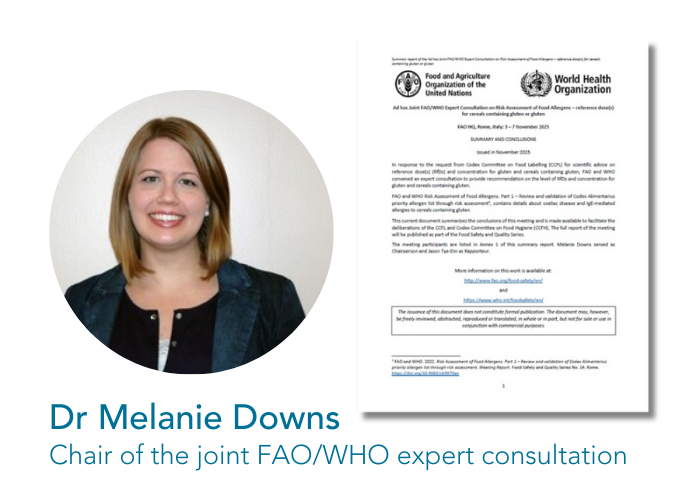
Chaired by Melanie Downs from the University of Nebraska-Lincoln and with Jason Tye-Din from Australia’s Walter and Eliza Hall Institute as rapporteur, the team reviewed the latest research on gluten exposure, food labelling, and detection methods. Their work involved modelling real-world eating habits and cross-contact risks to determine a safe reference dose for unintended gluten in food.
After careful analysis, the experts recommended a new reference dose of 4 mg gluten and wheat for risk assessment, replacing the previous 5 mg reference dose determined for wheat. This dose is recommended for use as a guide when precautionary allergen labelling is needed for cereals containing gluten, including wheat, while gluten-free labelling remains defined by Codex as 20 mg/kg or less.
Adopting this new reference dose is expected to improve labelling clarity, reduce unnecessary warnings, and expand safe food options for those affected by coeliac disease and wheat allergy. The group also called for better analytical methods and clearer labelling to further help consumers make safer choices.
Read a summary of the meeting report from the Ad hoc Joint FAO/WHO Expert Consultation on Risk Assessment of Food Allergens – reference dose(s) for cereals containing gluten or gluten here. The full report of the meeting will be published as part of a Food Safety and Quality Series at a later date.